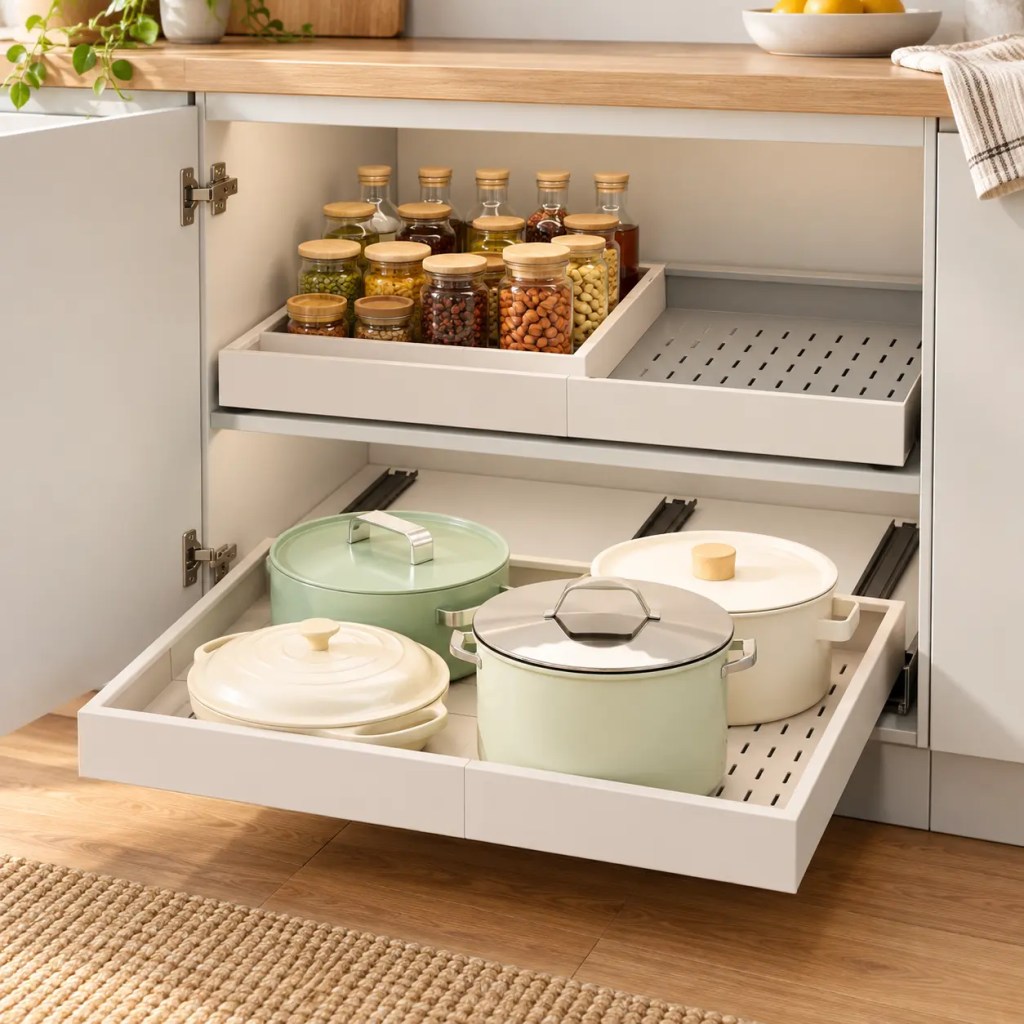
The Fokyfok Pull Out Cabinet Organizer is designed for a problem that becomes obvious once you live with a deep lower cabinet: the space at the back technically exists, but getting to it can mean moving everything in front first. This organizer converts that space into a pull-out platform while avoiding a permanently drilled installation.
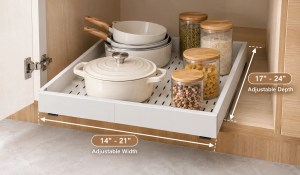
The more important part of the design, however, is its adjustability. The selected B0DL3R3MK1 version is specified for cabinet interiors from 14 to 21 inches wide and 17 to 24 inches deep. That gives it considerably more flexibility than an organizer built around one fixed cabinet size, but it does not mean it fits every cabinet inside those measurements automatically.
Fit is the first thing to check
The manufacturer makes one compatibility restriction unusually clear: this version is intended for cabinets without a raised front lip. That detail can matter more than the width or depth number because a lip at the front of the cabinet floor can interfere with the organizer’s sliding path.
Measure the usable interior width and depth rather than relying on the cabinet’s nominal size. Then inspect the route the organizer has to travel as it pulls forward. Door hinges, face-frame sections, plumbing, trim and the front edge of the shelf can all reduce usable clearance even when the basic interior dimensions appear suitable.
 Pin It
This makes the Fokyfok less of a universal cabinet accessory and more of a product that works well when its geometry matches the space. Spending a few minutes measuring first is more useful than choosing it solely because it is expandable.
Adjusting both width and depth is the main advantage
Many cabinet organizers solve only one sizing problem. A fixed-depth shelf may fit the width of the opening but leave unused space behind it, while a fixed-width drawer can be impossible to install in a slightly narrower cabinet. Here, both dimensions are adjustable.
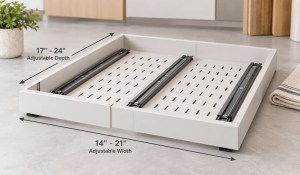
The selected version spans 14 to 21 inches in width and 17 to 24 inches in depth. That depth range is particularly relevant in cabinets where items tend to disappear behind the front row. Extending the organizer farther into the cabinet allows more of that space to move forward with the drawer instead of remaining difficult to reach.
There is still a practical boundary to that flexibility. A cabinet narrower than 14 inches, wider than 21 inches, shallower than 17 inches or deeper than 24 inches falls outside the stated sizing range. Adjustable does not mean infinitely adaptable.
 Pin It
The no-drill setup trades permanence for convenience
Fokyfok uses adhesive mounting for this version rather than requiring screws through the cabinet floor. For renters, recently finished cabinetry or anyone who simply does not want to drill holes, that is a meaningful difference.
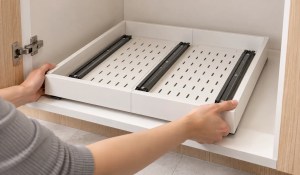
The installation concept is straightforward: position the organizer correctly, remove the protective film from the adhesive mounting surfaces and press the rails into place. Because the mounting method depends on adhesion rather than mechanical fasteners, getting the position right before committing the adhesive matters.
This is also where expectations should stay realistic. A no-drill adhesive organizer and permanently mounted cabinet hardware solve the same access problem in different ways. Buyers specifically looking for a structural, screw-mounted pull-out system may prefer hardware designed around that type of installation from the beginning.
 Pin It
What the three-rail design tells us, and what it does not
The organizer uses three guide rails rather than a single central track. Fokyfok describes this arrangement as improving support and sliding behavior under load. Structurally, having three rails is a real feature of the product, but the stronger performance language comes from the manufacturer.
One specification that deserves more caution is maximum weight. A dependable manufacturer-rated load capacity for this exact B0DL3R3MK1 variant was not established during our research. That means there is not enough evidence to turn phrases such as “heavy duty” into a specific number or to promise that the organizer is appropriate for very heavy appliances or cookware.
For normal cabinet organization, the more defensible benefit is accessibility. Items stored toward the rear can move forward with the shelf instead of requiring you to reach behind whatever is sitting in front.
Material and everyday layout
The product is listed with a carbon-steel frame and a height of about 3.3 inches. The low-sided layout keeps the contents visible instead of enclosing them in a tall drawer, which suits pantry goods, cookware and other items that benefit from quick visual access.
It is also a single-organizer package. That is worth remembering when planning a wider cabinet or several storage zones, since outfitting multiple cabinets requires multiple units rather than dividing a multi-pack.
[INSERT IMAGE: 1200 × 700 px | description: exact white Fokyfok organizer extended from a deep kitchen cabinet with a small practical selection of pantry containers or lightweight cookware arranged so the low sides, cabinet depth and pull-out access are visible | alt text: Fokyfok pull-out organizer providing access to items in a deep cabinet]
The buying decision comes down to the cabinet
The most useful part of this Fokyfok design is the combination of adjustable width, adjustable depth and no-drill installation. Those three characteristics address the two main frustrations of aftermarket cabinet organizers: getting the dimensions right and installing the hardware.
Its limitation is equally concrete. The organizer still needs the correct cabinet geometry. A raised front lip can rule it out entirely, and the specified adjustment ranges create firm minimum and maximum dimensions. There is also less verified information about maximum load capacity than we would want before recommending it specifically for unusually heavy storage.
For a deep, flat-bottomed cabinet that falls comfortably inside the sizing range, the design makes practical sense. For an incompatible cabinet opening, no amount of adjustability elsewhere will solve the fit problem. Measure the space, inspect the front edge, and decide from there.