
Under-sink storage is an unusual buying problem because the cabinet is rarely an empty rectangle. Drain pipes, supply lines, shutoff valves, garbage disposals, hinges, and the sink bowl itself can divide the usable space into several smaller zones. That is why a compact organizer that works around those obstacles can be more useful than a larger system with more theoretical capacity.
The five options researched for this guide take noticeably different approaches. Some are narrow freestanding drawer systems that can sit beside plumbing. Others use more cabinet height, mount directly to the cabinet floor, or turn a wide uninterrupted section of cabinet into a single pull-out tray. Understanding those differences is more useful than treating them as interchangeable products.
Measure the Cabinet You Actually Have
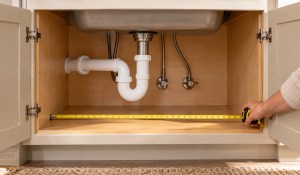
Start with the clear cabinet opening rather than the exterior cabinet width. Measure the usable width between the door frame and hinges, the depth available from the front opening to the rear wall or plumbing, and the height beneath the sink bowl. Then identify anything that interrupts those dimensions.
A pull-out also needs room to move. A unit can technically fit inside the cabinet while still hitting a hinge or door as it extends. Measure with the cabinet doors open in their normal position and think about the entire movement path, not just the space where the organizer will sit when closed.
Plumbing deserves its own sketch. Mark the P-trap or drain, supply lines, shutoff valves, garbage disposal if present, and any equipment that you may need to reach later. This quickly shows whether you have one large open zone or several narrow areas that should be organized separately.
 Pin It
Choose the Organizer Type Before the Brand
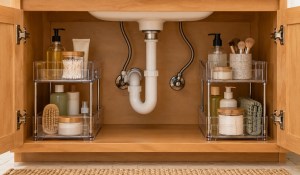
Compact freestanding two-tier organizers are usually the easiest type to place around awkward plumbing. Because they occupy a relatively narrow footprint, one unit can sit on each side of a drain or a single organizer can use whichever section of the cabinet remains open. They also avoid permanent installation, which can matter in rentals or cabinets that need frequent plumbing access.
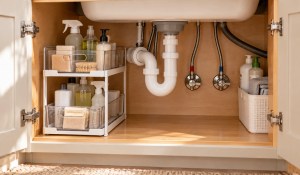
Taller metal two-tier organizers trade some flexibility for greater vertical use. They can make better sense when the cabinet has substantial clear height beside the plumbing and you want bottles or cleaning supplies separated across two levels. Height adjustment is useful here because a fixed upper tier can collide with the sink bowl or pipes.
Mounted pull-outs solve a different problem. Instead of placing a small drawer inside the cabinet, the slide hardware turns the organizer into part of the cabinet. This can produce smoother access in a deep cabinet, but the dimensions and installation location need to be right from the start.
Wide expandable pull-out trays are another category altogether. They work best when much of the cabinet floor is open and plumbing does not divide the usable area. Their strength is turning deep cabinet space into an accessible platform, not weaving around a complicated cluster of pipes.
How the Five Researched Options Differ
| Product | Format | Approximate Listed Fit | Installation | Main Reason to Consider It |
|---|---|---|---|---|
| Kitstorack Under Sink Organizer | Adjustable metal two-tier, 2-pack | 11.8 in. W × 15.9 in. D × 13.8 to 16.9 in. H | Freestanding with suction cups and adhesive films | Useful when vertical capacity and adjustable tier height matter |
| Delamu Under Sink Organizer | Clear modular two-tier drawers | 8.27 in. W × 13.19 in. D, with 9.06 and 10.63 in. listed heights | Tool-free freestanding assembly | Compact footprint, visibility, dividers, and flexible placement |
| Vtopmart 4 Pack Pull Out Organizer | Narrow clear two-tier drawers, 4-pack | 7.5 in. W × 11.8 in. D × 10 in. H per listed unit | Tool-free freestanding assembly | Splits storage into several narrow zones around obstructions |
| LYNK Professional 451118 | Two-tier cabinet-mounted pull-out | 11.5 in. W × 18 in. D × 14 in. H, minimum 12 in. opening | Hardware-mounted | Reversible design specifically intended to work around plumbing |
| Fokyfok Pull-Out Cabinet Organizer | Expandable low-profile pull-out tray | Listed 14 to 21 in. W × 17 to 24 in. D for the candidate variant | Adhesive, no-drill installation | Wide access platform for open, lip-free deep cabinets |
Kitstorack: When Height Adjustment Matters
The Kitstorack represents the larger freestanding metal approach. Its listing describes an 11.8-inch width, 15.9-inch depth, and five height positions covering roughly 13.8 to 16.9 inches. Both storage levels are designed for pull-out access, and the organizer uses suction cups plus adhesive films for stabilization rather than a conventional screw-mounted cabinet slide.
The main fit question is height. This is substantially taller than the compact Delamu and Vtopmart formats, so measure beneath the sink bowl and around horizontal plumbing before assuming that the adjustable feature solves every clearance problem. Its size makes more sense in a cabinet with a relatively tall open area beside the plumbing.
Delamu: Compact Drawers With More Internal Separation
The researched Delamu version uses a narrow 8.27-inch footprint and 13.19-inch depth. Its listing identifies two heights, 9.06 and 10.63 inches, along with four slide-out drawers and eight movable dividers in the two-unit configuration. Transparent drawers also make smaller supplies easier to identify without opening every compartment.
This format is worth considering when the cabinet is broken into smaller usable zones or when toiletries, packets, sponges, and other small items need more separation. It is less focused on supporting large bottles or heavy cookware than the larger metal designs.
Vtopmart: Four Narrow Units for Dividing the Cabinet
Vtopmart takes the narrow modular idea further by supplying four listed organizers in the researched configuration. Each unit is approximately 7.5 inches wide, 11.8 inches deep, and 10 inches high, with two pull-out levels. That narrow width can be useful when a central drain or disposal prevents one large organizer from spanning the cabinet.
The advantage is configuration rather than maximum capacity in one unit. You can treat the left and right sides of a cabinet as separate storage zones instead of forcing everything into a single frame. That approach can also make it easier to keep one section removable when plumbing access is needed.
 Pin It
LYNK Professional 451118: A More Permanent Plumbing-Aware Pull-Out
The LYNK 451118 is closer to installed cabinet hardware than a removable storage bin. The manufacturer lists dimensions of 11.5 inches wide, 18 inches deep, and 14 inches high, with a minimum 12-inch cabinet opening. Its two-tier structure is reversible so the storage section can be arranged on either side to accommodate the plumbing layout.
This approach makes sense when you have confirmed the dimensions and want a dedicated pull-out rather than a freestanding organizer. The trade-off is commitment. Because the unit installs with hardware, it is less convenient to remove than a simple modular drawer when the cabinet needs plumbing work or when a renter wants to avoid permanent mounting.
Fokyfok: For a Wide, Open Cabinet Floor
The Fokyfok candidate is different from the tiered under-sink products. Its listed variant expands from 14 to 21 inches in width and 17 to 24 inches in depth, creating a wide low-profile sliding platform. Installation uses adhesive rather than drilling.
The major limitation is also clearly stated: this exact version is intended for cabinets without a front lip. It also needs a much more continuous open footprint than the narrow organizers. That makes it more appropriate for an unusually open sink-base cabinet than for a cabinet crowded by central plumbing, a garbage disposal, and multiple supply lines.
Do Not Sacrifice Plumbing Access for Storage Capacity
An organizer can fit perfectly and still create a bad layout if it blocks the shutoff valves or makes the P-trap difficult to reach. Keep a practical route to those components. During a leak, the ability to reach a valve quickly matters more than fitting one additional bottle inside the cabinet.
Removability is therefore a legitimate buying criterion. Freestanding modular organizers can usually be lifted out or rearranged, while permanently mounted pull-outs require more planning. Neither approach is automatically better. The right choice depends on how constrained the cabinet is and how much of the plumbing sits inside the organizer’s footprint.
Also avoid assuming that every square inch needs to be filled. Leaving an open maintenance zone can make the cabinet easier to live with and easier to inspect for drips or leaks.
 Pin It
Your Final Under Sink Organizer Checklist
- Measure the clear cabinet opening between the frame and hinges.
- Measure usable depth with the doors and hinges in their normal positions.
- Check the lowest point of the sink bowl, pipes, and garbage disposal before choosing organizer height.
- Map the exact position of the drain, supply lines, and shutoff valves.
- Decide whether the cabinet has several narrow usable zones or one wide continuous area.
- Check whether a front cabinet lip could interfere with a pull-out system.
- Confirm that sliding drawers can extend without hitting the door or hinge.
- Choose between removable, adhesive, and screw-mounted installation deliberately.
- Leave enough room to reach plumbing components without dismantling the entire storage setup.
- Treat listed load capacities as manufacturer specifications unless independently tested.