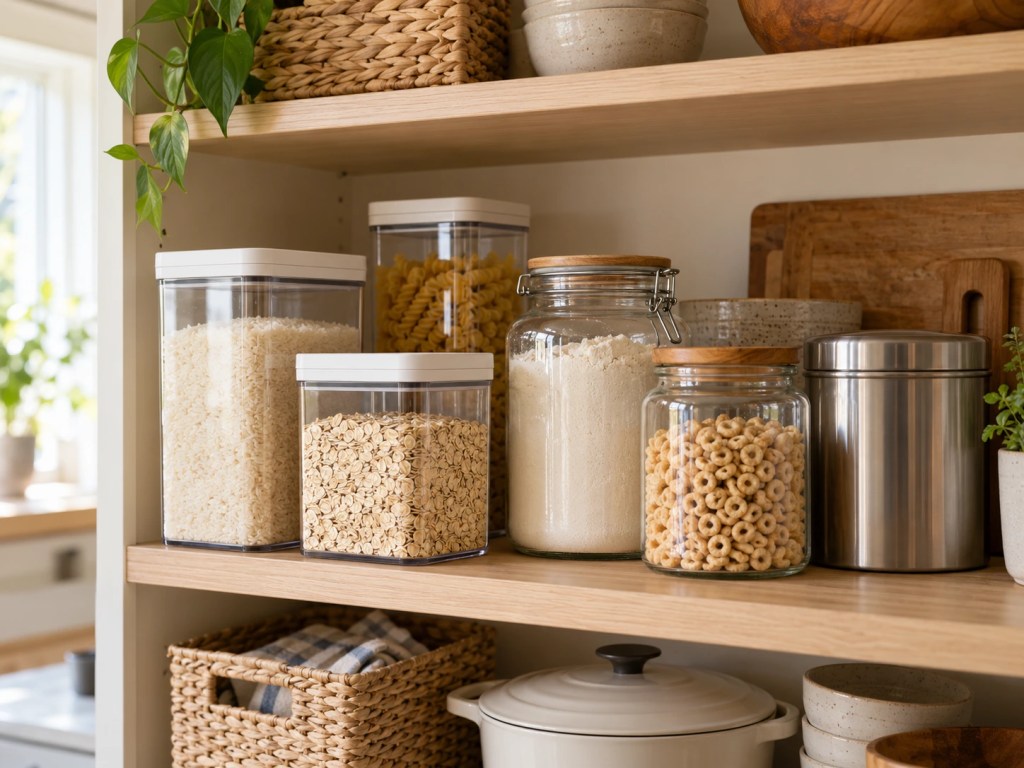
Airtight food storage containers are easy to shop by appearance. Rows of matching canisters make a pantry look organized, and a large piece count can make one set seem more useful than another. Neither tells you whether the containers will actually fit your shelves, hold the foods you buy, or be convenient to open and clean every week.
The better approach is to work backward from your pantry. Decide what needs to be stored, measure the space available, and then compare capacity, material, closure, access, and care. The six researched products in this guide illustrate different ways to solve that problem rather than forming a simple first-to-last ranking.
Start With the Pantry, Not the Container Set
Before comparing materials or lid mechanisms, measure the actual space where the containers will live. Record usable shelf width, depth, and height, including any space lost to shelf supports, door frames, hinges, or bins placed in front. A container that technically fits inside the cabinet may still be frustrating if there is not enough clearance to remove its lid or lift it from a stack.
Next, list the dry foods you genuinely want to decant. Flour, granulated sugar, brown sugar, rice, pasta, oats, cereal, coffee, baking ingredients, snacks, and nuts do not necessarily need the same container shape or capacity. This is why a 24-container mixed-size system and a six-container same-size system can both make sense for different households.
Do not use container count as the main buying metric. Twenty-four pieces are useful only if the available sizes correspond to the foods you store. Six identical containers can be more practical when most of your pantry staples are purchased in similar quantities.
 Pin It
Capacity and Opening Size Determine Everyday Use
Nominal capacity is useful, but it should not be read as a promise that a particular grocery package will fit. A quart of one ingredient does not weigh the same as a quart of another, and packaging sizes vary by brand. If your goal is to empty a complete bag of flour or sugar into one container, look for ingredient-specific capacity information instead of relying only on liters or quarts.
Opening size matters almost as much as total volume. Ingredients that you scoop regularly benefit from enough room for a measuring cup or scoop. A tall narrow container may use shelf space efficiently for pasta or cereal, while flour can be easier to manage in a wider opening that gives your hand and measuring tools more room.
The Progressive ProKeeper Baker’s set demonstrates this distinction clearly. Its containers are not simply different sizes of the same box. The flour, sugar, brown sugar, and powdered sugar keepers are configured around different baking tasks, including a flour leveler, sugar pour spout, brown-sugar terra cotta disk, and powdered-sugar accessories.
Choose Material by Handling and Care, Not Appearance Alone
Plastic is common in large pantry systems because it keeps weight relatively low and makes it practical to buy many matching containers at once. Clear plastic also makes it easy to check remaining food without opening the lid. The Vtopmart, Amazon Basics, Progressive, and DWËLLZA candidates all use plastic in different container and closure formats.
Glass offers a different experience. It is rigid, highly transparent, and can work particularly well when containers stay visible on open shelving or a countertop. The trade-off is greater weight and the possibility of breakage. The HomArtist set combines glass bodies with bamboo lids, which also creates a care split: the researched listing states that the glass bodies can go in the dishwasher but the bamboo lids should not.
Stainless steel is another option when a buyer prefers a metal body or wants canisters that can remain visible on a counter. The ENLOY set uses stainless steel bodies with transparent clamp lids, so the body itself does not provide the same all-around ingredient visibility as a clear container. Labels or viewing through the lid may therefore matter more.
Material labels should not replace model-specific care instructions. A dishwasher-safe body does not necessarily mean the gasket, bamboo lid, clamp assembly, or other lid components should be cleaned the same way.
 Pin It
Closure Design Changes the Daily Routine
“Airtight” describes an intended sealing function, but the products researched here reach that goal in different ways. Vtopmart uses side-locking lids with silicone gaskets. Amazon Basics uses a twist-to-close lid with a built-in gasket. DWËLLZA uses a lid mechanism that seals when its top ring is pushed down. ENLOY uses a clamp-style closure, while HomArtist pairs glass jars with fitted bamboo lids.
There is no basis here for claiming that one of those mechanisms creates the strongest seal. A more useful buying question is simpler: which closure are you likely to operate correctly every time?
A secure lid that is annoying to align, wash, or open may be less convenient in daily use than a different mechanism that fits your routine.
Lid interchangeability can also matter in a large system. Vtopmart’s 24-container configuration uses the same lid format across its four container sizes, reducing the need to match several lid shapes after washing. Other buyers may prefer the visual and stacking consistency of six identical DWËLLZA containers instead.
Which Storage Approach Fits Your Pantry?
The six researched sets fall into several distinct approaches. Thinking about them this way is more useful than trying to rank them from first to sixth.
For a Larger Pantry Reset
Vtopmart and Amazon Basics both target shoppers who want a coordinated plastic storage system, but they approach the job differently.
The Vtopmart 24-piece set is the larger commitment. It includes containers across four sizes and is better suited to a pantry where many different dry goods will be transferred at once. The main question is not whether 24 containers sound useful, but whether you actually need six containers in each included size.
Amazon Basics takes a smaller mixed-capacity approach. Its ten containers are divided across five capacities, giving you more size variation with fewer total containers. Its twist-to-close lids also create a different daily experience from Vtopmart’s side-locking design.
For a full pantry conversion, Vtopmart offers more pieces. For a more limited collection of staples with a wider spread of capacities, the Amazon Basics format may be easier to match to an existing pantry.
For Baking or Repeated Same-Size Storage
Progressive and DWËLLZA show why not every pantry benefits from a general-purpose mixed set.
The Progressive ProKeeper Baker’s set is designed around specific baking ingredients. Flour, granulated sugar, brown sugar, powdered sugar, and smaller baking staples receive containers or accessories suited to those tasks. That specialization can be valuable for frequent bakers, but it also makes the set less flexible for someone mainly storing cereal, pasta, rice, or snacks.
DWËLLZA takes the opposite route. Instead of assigning different shapes and features to different foods, the researched six-pack uses six identical nominal 1-liter containers. The advantage is predictable stacking and a consistent shelf layout.
That works best when several ingredients need roughly similar volumes. It becomes less efficient if your pantry includes both very small quantities and bulky staples that need much larger containers.
For Glass or Stainless Steel Storage
HomArtist and ENLOY are useful alternatives for shoppers whose material preference matters as much as modular stacking.
The HomArtist set uses clear borosilicate glass jars with bamboo lids. The glass construction keeps contents visible from almost every angle and gives the set a different visual character from rectangular plastic pantry systems. It also means more weight, breakage risk, and separate lid care.
One detail needs attention before purchase: the researched Amazon listing contains inconsistent capacity wording for the apparent HomArtist variant. The live product page should therefore be checked rather than relying on one exact volume figure.
ENLOY uses stainless steel canisters with transparent clamp lids. The wide openings can be practical for scooping and refilling, while the metal bodies create a more opaque storage format than clear plastic or glass.
That difference matters more than appearance alone. If seeing the remaining quantity from across the pantry is important to you, a fully transparent container has an advantage. If you prefer metal canisters for visible countertop or shelf storage, the ENLOY approach may fit better.
 Pin It
Do You Need One System for Everything?
Probably not.
A pantry can work perfectly well with more than one storage approach. Large rectangular containers may make sense for flour, rice, cereal, or pasta, while smaller matching jars may work better for nuts, seeds, coffee, or frequently used baking ingredients.
The goal should be consistency where consistency is useful, not uniformity for its own sake.
This is especially important when shopping for large sets. Buying 20 or more matching containers can create an attractive pantry, but unused sizes still take up storage space. A smaller mixed set, repeated modules, or a combination of container types may better match the foods you actually keep at home.
Your Final Pantry Container Checklist
Before choosing a set, check the following:
- Measure usable shelf width, depth, and height instead of relying on cabinet exterior dimensions.
- List the foods you plan to decant before deciding how many containers you need.
- Check whether each container can hold the quantity of the ingredient you normally buy.
- Choose between mixed capacities and repeated same-size modules based on your actual pantry inventory.
- Make sure scoopable ingredients have an opening wide enough for the tools you use.
- Choose a closure mechanism you will reliably seal after every use.
- Check cleaning instructions separately for container bodies, lids, gaskets, bamboo components, and metal finishes.
- Decide how important full ingredient visibility is before choosing clear, partly transparent, or opaque materials.
- Verify the exact live product variant whenever marketplace listings offer multiple colors, capacities, or set configurations.
- Do not pay for specialized baking accessories unless those features match ingredients you regularly store.
A good pantry storage system should make ingredients easier to identify, access, refill, and protect without creating a new organization problem. Measure first, match capacities to real foods, and then let material and lid style decide between the container systems that actually fit those requirements.